Last Updated Oct - 06 - 2023, 07:51 PM | Source : The Indian Express | Visitors : 155
The fifth Aditya-L1 workshop at IIT Kanpur educated students on solar research, including observational features of the Sun.
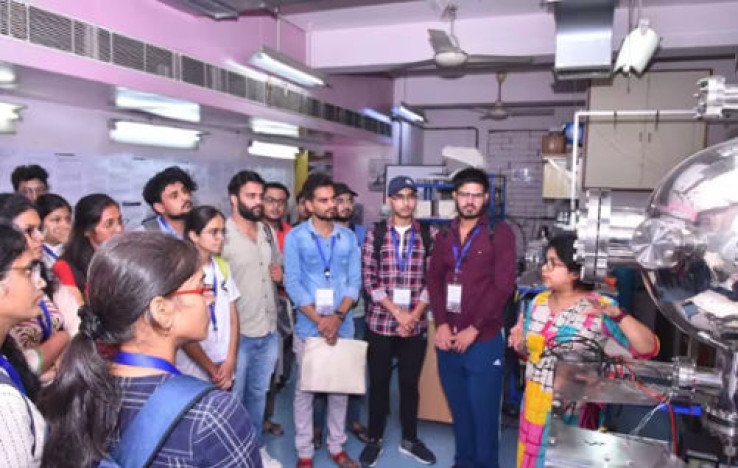
The fifth Aditya-L1 workshop was held at the Indian Institute of Technology, Kanpur (IITK). The Department of Physics at IIT Kanpur and the Aditya-L1 Support Cell at the Aryabhatta Observational Science Research Institute (ARIES), Nainital, jointly hosted this three-day workshop.
READ MORE| UPSC CDS Exam II 2023 Result Announced
A total of 50 students were chosen for this workshop, 20 from IIT Kanpur and the local universities and 30 from outside sources. They were chosen based on how well they performed academically in the relevant courses.
The institute intended to provide selected final-year undergraduate (UG), MSc, and PhD students with instruction in the use of future satellite data through this workshop.
The introduction of the Sun's observational features was the main goal of the workshop's second day. It discussed the methods used by researchers to study a variety of solar phenomena, including solar flares, solar wind, solar coronal mass ejections, and solar energetic particles. Participants received practical instruction in the usage of the magnetohydrodynamic code PLUTO, a numerical astrophysics system used to calculate the origin of solar storms.
Participants also visited the Plasma lab of Prof. Sudeep Bhattacharjee in the Department of Physics to learn about the generation and confinement of plasma in the laboratory. “As the Sun is essentially a spherical ball of plasma, this lab visit provided participants with a real sense of what plasma might look like. Additionally, participants visited the accelerator lab of Prof. Aditya Kelkar in the Department of Physics to learn about the acceleration of particles like electrons and protons, a process that occurs continuously in the Sun,” the official release stated.
The workshop's third day was devoted to the Aditya-L1 mission, where participants were helped to understand the complexity of mission payloads through theoretical and observational comprehension, according to the institute.
India has launched a satellite to the Sun for the first time as part of the ISRO project Aditya-L1 in order to research the Sun, its atmosphere, and its effects on Earth.
READ MORE| UGC NET 2023 Application Window Opened, Apply Now on ugcnet.nta.nic.in

Jun - 12
A LinkedIn post about a Gen Z employee refusing to attend a 9 PM meeting has gone viral, sparking a fresh debate on work-life balance and workplace... Read More
Jun - 09
CUET UG 2026 Answer Key: The National Testing Agency (NTA) is expected to release the CUET UG 2026 provisional answer key soon on its official webs... Read More

Jun - 09
JEE Advanced 2026 results declared and counselling in progress, students are now deciding which engineering branch to choose for their future caree... Read More