Last Updated May - 31 - 2024, 07:58 PM | Source : Education Times | Visitors : 124
IIT Madras-incubated Agnikul launches the world's first rocket with a single-piece 3D-printed engine from Sriharikota. The mission features India's first privat
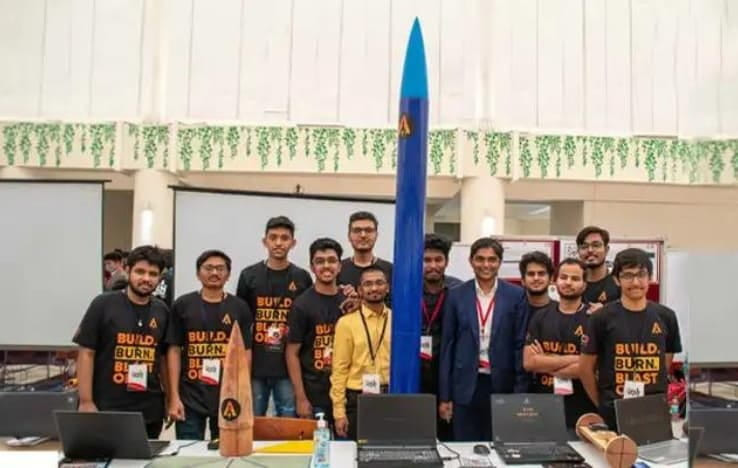
The IIT Madras-incubated business launched the world's first rocket with a single-piece 3D-printed engine from Sriharikota, aiming to enable launches from anywhere, at any time, and at an affordable price. This achievement was accomplished totally via local design and development.
The 'Agnibaan—SOrTeD' Sub-Orbital Technology Demonstrator is also unusual in that it was launched from India's first private launch pad, 'Dhanush,' which Agnikul constructed. This is also India's first rocket launch fueled by a semi-cryogenic engine.
The primary goal of this mission, which is also Agnikul's maiden flight, is to act as a test flight, demonstrating in-house and home-grown technology, gathering critical flight data, and ensuring the optimal operation of Agnikul's orbital launch vehicle, the 'Agnibaan'.
The launch was witnessed by various luminaries, including dignitaries S Somanath, chairman, Indian Space Research Organisation (ISRO); Pawan Goenka, chairman, IN-SPACe; Shri Rajeev Jyoti, director (Technical), IN-SPACe; and A Raj Rajan, director, SHAR. Agnikul’s core team members were also present.
Congratulating Agnikul on the launch, S Somanath, chairman of ISRO, said, “The success involving many firsts, including a 3D-printed semi-cryogenic engine, flight control systems, etc., demonstrate the prowess of indigenous design and innovation. It motivates ISRO to support Space startups and non-governmental entities for innovation and Atmanirbharata to create a vibrant space ecosystem in the country.”
Highlighting the significance of this historic milestone, Prof V Kamakoti, director of IIT Madras, said, “Sky is no longer the limit for our startups. Very innovative, first time in the world, deep core technology demonstrated today by Agnikul – a great inspiration for all young students to take the entrepreneurship route and become employers boldly comprises.”
The Agnikul team consists of over 200 engineers and is associated with NCCRD at IIT Madras. Additionally, the team is guided by 45 former scientists from ISRO who bring invaluable expertise to democratising access to space.
For Agnikul, the journey looks bright. The startup is looking at flying an orbital mission towards the end of the financial year of 2025 and is working with customers on flights starting regularly from CY 2025.
Agnikul Cosmos is an Indian space technology startup headquartered in Chennai. It was incubated by IIT-Madras, and Agnikul's vision is to bring space within everyone’s reach. Highlighting the significance of this historic milestone, Prof V Kamakoti, director of IIT Madras, said, “Sky is no longer the limit for our startups. Very innovative, first-in-the-world deep core technology demonstrated today by Agnikul—has achieved a significant milestone by developing the world's first and only single-piece 3D-printed rocket engine, for which it holds a patent.
Stay ahead with educational updates! Join our WhatsApp channel now for the latest insights and knowledge boosts. Don’t miss out, join today!
READ MORE| Dharmendra Pradhan Launches 3-Year Partnership with Meta for Education Empowerment

Jun - 12
A LinkedIn post about a Gen Z employee refusing to attend a 9 PM meeting has gone viral, sparking a fresh debate on work-life balance and workplace... Read More

Jun - 09
CUET UG 2026 Answer Key: The National Testing Agency (NTA) is expected to release the CUET UG 2026 provisional answer key soon on its official webs... Read More

Jun - 09
JEE Advanced 2026 results declared and counselling in progress, students are now deciding which engineering branch to choose for their future caree... Read More